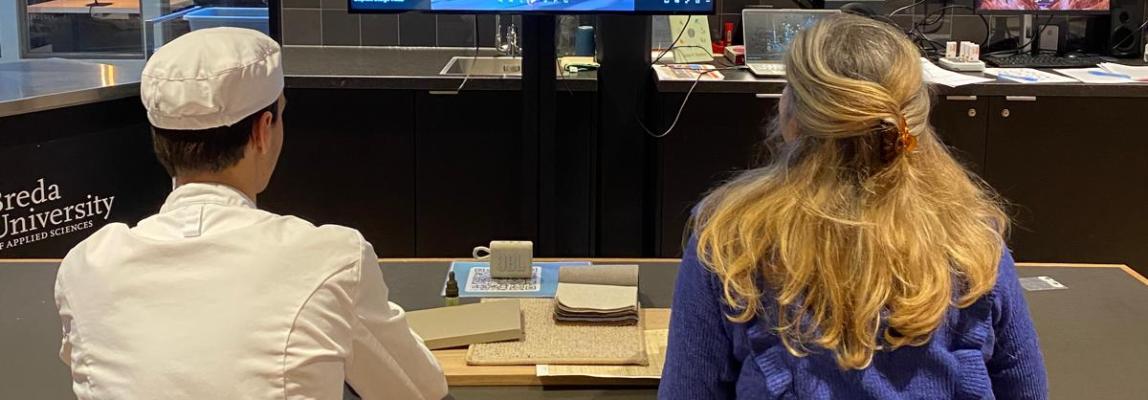
Graduation student Jessie researched how scent, sound, light and touch shape how relaxed we feel in a space.
Research
Student work
Taste Lab
Think about the last time you walked into a hotel, restaurant or café. Within seconds you felt something: calm or restless, welcome or out of place. But why? Graduation student Jessie wanted to find out. In her Bachelor Thesis, she researches how spaces can help people relax and feel connected to others, using only the senses.
What is Sensory Design? Sensory Design means shaping the atmosphere of a space on purpose. The texture of a wall, the shade of a light or the way furniture is placed can change how you feel within seconds. Jessie looks at how hotels, restaurants and cafés can use this to make guests feel at ease.
How did the experiment work? Jessie created two different spaces and showed them on a big TV screen in the TasteLab. Alongside each image, participants heard sounds, touched materials and smelled scents that matched the space. Halfway through, part of the atmosphere changed. The question: how do body and feelings respond?
To measure this, participants wore a small sensor on two fingers. It picks up tiny changes in the skin that show how strongly the body reacts.
Before the first space and between the two spaces, participants rested and silently counted coloured shapes on a card. This gave their body a neutral starting point. After each space, they filled in a short rating card. At the end, they talked with Jessie about what they had noticed.
What happens with the results? Jessie combines the sensor data, the rating cards and the conversations to see which sensory choices help people relax. All results are used anonymously and only for her Bachelor Thesis.